Even When You Don’t Notice It
When most people think about sun damage, they picture heat, holidays, and long days spent outdoors. But in reality, the majority of skin damage doesn’t happen in those obvious moments. It happens quietly. Gradually. And often, completely unnoticed.
Even in the UK, where the sun doesn’t always feel strong, your skin is exposed to ultraviolet (UV) radiation every single day. Up to 80% of UV rays are still able to pass through cloud cover, which means that even on overcast days, your skin is still receiving a level of exposure.
What’s more, certain types of UV radiation can pass through glass, meaning that time spent driving, sitting near windows, or working in bright indoor spaces can all contribute to long-term skin damage.
This is where the misunderstanding begins, because if you can’t feel it, and you can’t see it, it’s easy to assume it isn’t happening.
But beneath the surface, your skin is responding to that exposure in ways that only become visible much later.
Understanding What UV Is Actually Doing to Your Skin
Ultraviolet radiation is made up of different types of rays, primarily UVA and UVB, and each one affects the skin in a very different way.
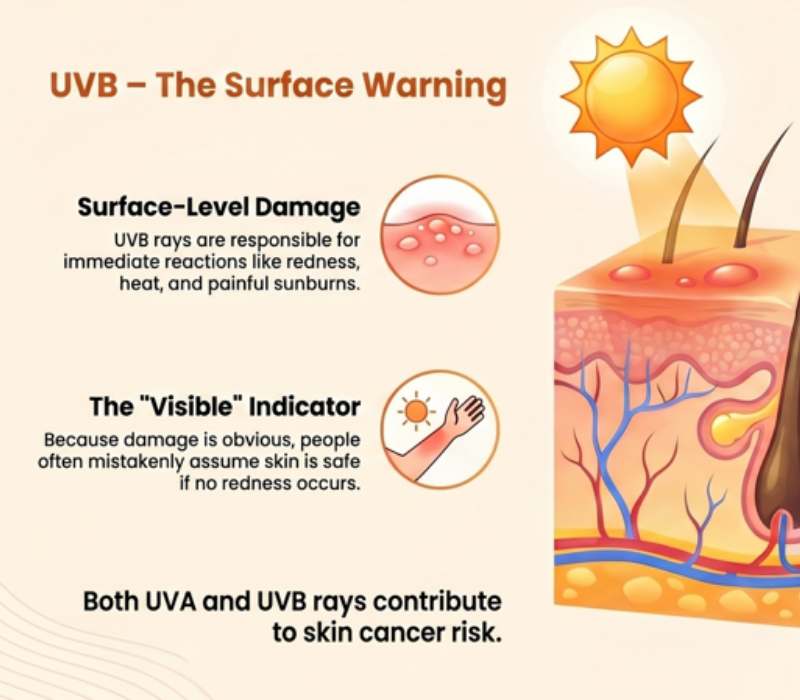
UVB rays are the ones most people are familiar with. They are responsible for sunburn, redness, and that immediate visible reaction when the skin has been exposed for too long. Because UVB damage is so obvious, it tends to shape how people think about sun protection, if there’s no redness, no discomfort, and no heat, then it must be safe.
However, UVA rays behave very differently.
Rather than affecting the surface, UVA penetrates deeper into the skin, reaching the layers where collagen and elastin are produced. These are the structural components that keep skin firm, smooth, and resilient. Over time, repeated exposure to UVA rays breaks these fibers down, weakening the skin’s support system and leading to fine lines, loss of elasticity, and a more uneven texture.
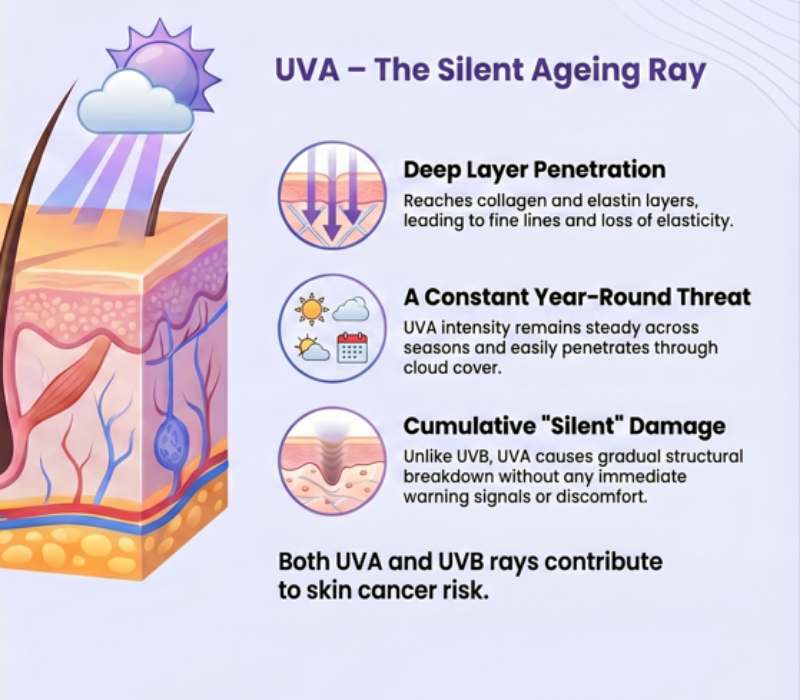
Unlike UVB, this process is silent. There is no immediate sign that damage is occurring. No redness, no warning signal, just gradual changes
UVA exposure is also constant throughout the year. It does not fluctuate in the same way as temperature, and it is not significantly reduced by cloud cover. This is why skin ageing is not purely a result of “sunny days,” but rather the accumulation of everyday exposure over months and years.
Both UVA and UVB also play a role in the development of skin cancers, which is why protection is not simply a cosmetic concern, but a health one as well.
Why Skin Changes Often Seem to ‘Appear’ Suddenly
One of the most common things people notice is that their skin appears to change quite quickly, particularly during or after the summer months. Pigmentation becomes more visible. Fine lines seem more pronounced. Skin can look duller or less even.
It can feel as though this has happened suddenly, but in reality, these changes are usually the result of cumulative exposure. The summer simply brings them to the surface.
Collagen does not break down overnight. Pigmentation does not form in a single day. These are processes that develop slowly, beneath the surface, until they reach a point where they become visible.
This is why prevention is so much more effective than correction. Once these changes are established, they are significantly harder to reverse.
Where Sunscreen Fits Into This, and Why It Can Be Confusing

Sunscreen is often spoken about in very simple terms, as though it is a single, straightforward product that either works or doesn’t.
In reality, it is slightly more nuanced than that.
There are two main categories of sunscreen: chemical (sometimes referred to as synthetic) and physical (or mineral). Both are designed to reduce the amount of UV radiation reaching the skin, but they do so in different ways.
Chemical sunscreens are formulated to absorb UV radiation and convert it into heat, which is then released from the skin. These tend to be lightweight, easy to apply, and cosmetically elegant, which is why they are often preferred for daily use, particularly on the face.
However, not all chemical sunscreens provide the same level of protection across both UVA and UVB. Some formulations are more focused on preventing burning (UVB), which can give a false sense of security if UVA protection is limited.
Physical sunscreens, on the other hand, sit on the surface of the skin and act as a barrier, reflecting UV rays away. They typically contain ingredients such as zinc oxide or titanium dioxide, which naturally provide broader spectrum protection across both UVA and UVB.
They can feel slightly heavier on the skin and may leave a visible cast, but they are often better tolerated by sensitive or reactive skin types.
What matters most, regardless of which type you choose, is that the product offers broad-spectrum protection (both UVA & UVB) and is used consistently.
The Role of Everyday Habits in Long-Term Skin Health
One of the biggest misconceptions around sunscreen is that it is something you apply for specific occasions, holidays, hot days, or prolonged time outdoors.
In reality, the most significant impact comes from everyday use.
Short periods of exposure, repeated consistently, are often more damaging over time than occasional intense exposure. The walk to the car, sitting in traffic, time spent outdoors running errands, these moments may feel insignificant, but they accumulate.
This is also where layering can play a helpful role. Many mineral-based makeup products now contain small amounts of UV-protective ingredients such as zinc oxide or titanium dioxide. While they are not sufficient as a primary form of protection, they can provide an additional layer, helping to reinforce your sunscreen throughout the day.
It is not about achieving perfection, but about creating consistency.
A Different Way to Think About Skin Protection
Healthy skin is often associated with treatments, products, and corrective approaches, what can be added, improved, or reversed. But in many cases, the most impactful shift comes from protection.
Protecting collagen before it breaks down.
Preventing pigmentation before it becomes visible.
Maintaining the skin’s integrity rather than trying to rebuild it later.
Because the reality is, most visible aging is not the result of time alone. It is the result of exposure. And the earlier that is understood, the easier it becomes to preserve the quality, clarity, and resilience of the skin long-term.
Understanding this is where things start to shift.
Because once you realise that so much of what you see in the skin is the result of cumulative exposure, the focus naturally moves from reacting… to protecting and supporting the skin more intentionally.
That’s exactly how we approach it in the clinic.
Daily protection is always the foundation. We work with broad-spectrum SPF within skincare, including moisturisers that protect against both UVA and UVB, as well as mineral-based options that sit comfortably on the skin and are easy to wear every day. Many clients also like to layer this with mineral makeup, which contains zinc oxide and titanium dioxide, adding an extra level of light protection throughout the day without feeling heavy.
It’s not about relying on one product, it’s about creating consistency through what you’re already using.
Alongside that, we look at how we can support the skin where damage has already started to show.
Pigmentation, uneven tone, and changes in skin texture are some of the most common concerns linked to UV exposure, and there are a number of ways we can begin to improve this gently and progressively.
Chemical peels, particularly glycolic-based peels, are one of the most effective ways to start lifting pigmentation and encouraging a more even, brighter complexion. They work by accelerating the skin’s natural renewal process, helping to bring fresh, healthier skin to the surface over time. Salicylic peels can also be used depending on the skin type and condition, especially where congestion is a factor.
For deeper support within the skin, microneedling is one of the most effective treatments for rebuilding collagen and elastin. By stimulating the skin’s natural repair response, it helps to strengthen the structure of the skin, improve texture, and soften the visible effects of sun damage over time.
Meso-based treatments can also play a role here, working more gradually to support hydration, skin quality, and overall balance, particularly where the skin feels depleted or lacking in vitality.
What’s important is that these treatments are not about quick fixes. They are about working with the skin, restoring what has been affected, and supporting it in a way that feels sustainable.
Because while we can improve the visible signs of sun damage, the most powerful results always come from combining treatment with daily protection.
That’s what allows the skin not just to improve, but to stay that way.